Email: [email protected]
Telephone: +86-0512-65028068
Er verdwijnt van de ene op de andere dag een kentekenplaat uit een bestelbusje. Een scheidingswand van een toilet zwaait los omdat iemand elke sluiting met een muntstuk heeft losgemaakt. Een transit shelter verliest voor de derde keer dit kwartaal zijn toegangspaneel. In alle drie de gevallen ligt het falen niet in de sterkte van de schroef, maar in het feit dat een standaard platkop- of kruiskopschroevendraaier op de kop past. De beste veiligheidsschroef is dus niet één universeel onderdeel. Het is de combinatie van een manipulatiebestendige aandrijving, een materiaal dat is afgestemd op de omgeving en een sleutelbeheerplan waar uw onderhoudsteam daadwerkelijk mee kan leven. Voor de meeste openbare en buiteninstallaties is roestvrijstalen schroeven met snake-eye-, pentagon- of pin-in-Torx-drives zorgen voor de praktische balans tussen afschrikking en bruikbaarheid; voor locaties met een hoog risico rechtvaardigt een aangepaste aandrijving, die geen kant-en-klaar gereedschap gebruikt, de gereedschapskosten.
Er worden twee termen door elkaar gebruikt, maar ze beschrijven verschillende beschermingsniveaus. Fraudebestendige schroeven ontmoedigen toevallige inmenging: hun aandrijfgeometrie – een uitsparing met slangenoog, een Torx-lob met een centrale pin, een vijfhoekige of zevenhoekige dop – kan niet worden vastgegrepen door de schroevendraaiers die mensen gewoonlijk bij zich dragen. Fraudebestendige schroeven leggen de lat nog hoger: de schijf is zo ongebruikelijk dat zelfs een vastberaden persoon een gespecialiseerde sleutel nodig heeft die niet bij de hardwarebalie wordt verkocht, en sommige ontwerpen zijn eenrichtingsverkeer, wat betekent dat ze kunnen worden geïnstalleerd maar niet kunnen worden verwijderd met conventioneel gereedschap.
Het helpt ook om beveiligingsschijven te scheiden van anti-loslatingsfuncties. Een nylon patch of een volledig metalen borgelement zorgt ervoor dat een schroef niet losschiet onder trillingen; een veiligheidsaandrijving houdt iemands gereedschap uit het hoofd. Buitenconstructies hebben meestal beide nodig. Daarom specificeren veel kopers een fraudebestendige schijf met een vergrendelingspatch in hetzelfde onderdeel.
De aandrijfgeometrie vormt de kern van de beslissing, en elke optie wisselt afschrikking af met onderhoudsgemak. De onderstaande tabel geeft een overzicht van de schijftypen die verantwoordelijk zijn voor de meeste aankopen van beveiligingsschroeven in de echte wereld.
| Aandrijvingstype | Hoe het bestand is tegen manipulatie | Typische toepassingen | Onderhoudsgemak |
|---|---|---|---|
| Slangenoog (sleutel) | Twee kleine gaatjes in de kop; standaardmessen en Phillips-punten hebben geen grip | Kentekenplaten, bewegwijzering, toilethokjes, openbaar meubilair | Afneembaar met een bijpassende steeksleutel |
| Torx met centrale pin | Ziet eruit als een standaard 6-lobben Torx, maar een centrale pin blokkeert normale drivers | Elektronicabehuizingen, kiosken, consumentenhardware | Verwijderbaar met pin-in Torx-sleutels |
| Vijfhoek / zevenhoek | Ongewone lobtellingen waarbij geen standaard socket of driver overeenkomt | Nutsbehuizingen, doorvoerarmaturen, speeltoestellen | Alleen verwijderbaar met de speciale sleutel |
| Drie-groef | Conische kop met drie groeven en geen interne aandrijving voor gewoon gereedschap | Zonne-montagesystemen, betaalterminals, diefstalgevoelige buitenapparatuur | Vereist een speciale tri-groef socket |
| Eenzijdig gesleufd | Schuine sleuven zorgen ervoor dat een platte kop kan worden vastgedraaid, maar komt naar buiten bij omgekeerd koppel | Vaste armaturen, inbouwplaten | Verwijdering is meestal destructief; plan daarvoor |
De afweging die u in gedachten moet houden: hoe exotischer de rit, hoe sterker de afschrikking – en hoe moeilijker uw eigen noodonderhoud wordt. Een slangenoogschroef op een scheidingswand in een toilet is in vijf seconden te repareren met de juiste sleutel; driegroefbevestigingen die op tien locaties zijn geïnstalleerd, betekenen tien doppensets, of één sleutel met rupsband die de gereedschapsbak nooit verlaat.
Hardware voor voertuig- en straatmeubilair wordt geconfronteerd met opportunisten met multitools in zakformaat, zodat de drive alleen het gewone gereedschap hoeft te verslaan – maar het materiaal moet regen, strooizout en autowaschemicaliën overleven. Een roestvrijstalen schroef met ronde kop in M4 met een uitsparing met slangenoog is hier de klassieke keuze: roestvrij staal is bestand tegen corrosie en de kop met twee gaten verslaat pogingen tot munt- en tangen. Voor gemeentelijke bewegwijzering voegen vijfhoekige of zevenhoekige aandrijvingen een tweede laag toe, omdat hun sleutels geen deel uitmaken van een standaard gereedschapsset.
M4 roestvrij stalen veiligheidsschroef met bolkop en snake-eye-aandrijving.jpg) M4 roestvrijstalen pankop-veiligheidsschroef met snake-eye-aandrijving Een corrosiebestendige M4 roestvrijstalen panhead-schroef met een twee-gats snake eye-uitsparing die gewone munt- en tanggereedschappen verslaat, zeer geschikt voor voertuig- en straatmeubilair dat wordt blootgesteld aan regen, strooizout en autowaschemicaliën. Bekijk Product →
M4 roestvrijstalen pankop-veiligheidsschroef met snake-eye-aandrijving Een corrosiebestendige M4 roestvrijstalen panhead-schroef met een twee-gats snake eye-uitsparing die gewone munt- en tanggereedschappen verslaat, zeer geschikt voor voertuig- en straatmeubilair dat wordt blootgesteld aan regen, strooizout en autowaschemicaliën. Bekijk Product → Binnenin apparaten bestaat de dreiging meestal uit nieuwsgierige handen of ongeoorloofd onderhoud, in plaats van regelrechte diefstal. Pin-in Torx- en pentagon-aandrijvingen domineren, vaak in kleine maten van M1 tot M3, waarbij kophoogte en schroefdraadprecisie net zo belangrijk zijn als de aandrijving zelf. Een vijfhoekig onderdeel met knopkop past bij bedieningspanelen en toegangsluiken die technici maandelijks openen, maar die nooit door het publiek mogen worden geopend. Als er sprake is van trillingen, voegt u een nylon patch toe zodat de aandrijving het werk van het slot niet doet.
roestvrijstalen bolkop vijfhoekige fraudebestendige schroef met sleutel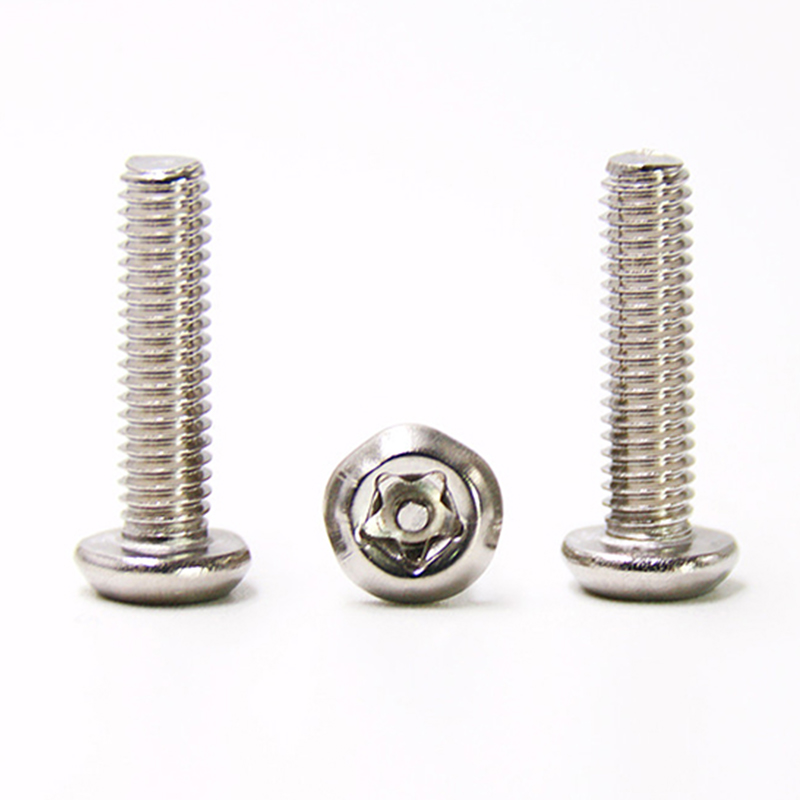 Roestvrijstalen knopkop Pentagon-manipulatieschroef met sleutel Een roestvrijstalen bolkopschroef met vijfhoekige aandrijving en bijpassende sleutel, passende bedieningspanelen en toegangsdeksels in het M1 tot M3-assortiment waar kleine afmetingen, precieze schroefdraad en een niet-standaard aandrijving het publiek buiten houden. Bekijk Product →
 Blootstelling verandert de specificatie meer dan de dreiging. Afgedichte varianten – een O-ringgroef onder de kop of een afdichtende coating op de schroefdraad – houden water uit het geheel, terwijl een borgpatch de klemkracht vasthoudt waar u deze instelt. In kustgebieden of omgevingen met een hoog chloridegehalte kunt u overstappen op roestvrij staal 316 in plaats van alleen op beplating te vertrouwen, omdat een verroeste veiligheidsschroef snel een standaardvormig gat in uw beschermingsplan wordt.
M4 koolstofstalen zwarte antidiefstalschroef met nylon patch-1.jpg) M4 koolstofstaal zwarte antidiefstalschroeven met nylon patch Een zwarte M4 koolstofstalen antidiefstalschroef met een nylon vergrendelingspatch die de klemkracht onder trillingen behoudt, wat illustreert hoe materiaal- en vergrendelingskeuzes de installatieomgeving en blootstellingsomstandigheden moeten volgen. Bekijk Product →
M4 koolstofstaal zwarte antidiefstalschroeven met nylon patch Een zwarte M4 koolstofstalen antidiefstalschroef met een nylon vergrendelingspatch die de klemkracht onder trillingen behoudt, wat illustreert hoe materiaal- en vergrendelingskeuzes de installatieomgeving en blootstellingsomstandigheden moeten volgen. Bekijk Product → Een beveiligingsrit is waardeloos als de schroef roest, losraakt of losraakt voordat de dreiging ooit opduikt. De materiaalkeuze moet in de eerste plaats de installatieomgeving volgen en in de tweede plaats het budget:
Twee toleranties verdienen aandacht bij het bestellen. De schroefdraadpassing is belangrijk: een M4-veiligheidsschroef moet soepel in een tapgat of moer lopen zonder kruislingse schroefdraad, omdat veldploegen die tegen een installatie moeten vechten hem uiteindelijk zullen verwisselen voor een standaardschroef. De stijl van de kop is ook belangrijk: verzonken koppen zitten vlak op platen en panelen, terwijl pan- en knopkoppen meer metaal achterlaten rond de schijfuitsparing, waar de sabotagebestendigheid feitelijk leeft.
Het beveiligingsniveau van het gehele systeem is gelijk aan het niveau van uw sleutelbeheer. Een vijfhoekige aandrijving met veertig gedupliceerde sleutels die aan een ophangbord hangen, is niet veiliger dan een kruiskop. Behandel de sleutel voordat u bestelt als onderdeel van de stuklijst: beslis wie de sleutels bezit, hoe reserveonderdelen worden opgeslagen en hoe een verloren set wordt vervangen. Fabrikanten gaan hier anders mee om, dus vraag het direct. Sommigen leveren één sleutel per vast aantal schroeven, anderen leveren afzonderlijk gecodeerde sets met maximale aantallen.
Dat laatste punt is waar de capaciteiten van leveranciers tot uiting komen. EEN aangepast beveiligingsschroefprogramma werkt alleen als de fabrikant de vormgereedschappen achter de kop controleert: matrijzen met koude kop, ponspennen en draadwalsmatrijzen die consistent een ongebruikelijke uitsparing reproduceren over tienduizenden stukken. Werken met een fabrikant van precisieschroeven die zijn eigen gereedschappen in eigen huis bouwt verkort dat traject, omdat er een prototype van een op maat gemaakte vijfhoekige of drielobbige aandrijving kan worden gemaakt en gecorrigeerd zonder dat de matrijzen uitbesteed hoeven te worden.
Er bestaat niet één ‘beste’ beveiligingsschroef; alleen de beste match voor een specifieke bedreiging, omgeving en onderhoudsplan. Begin met de schijf die de gereedschappen blokkeert die uw locatie daadwerkelijk aantrekt, specificeer roestvrij of gecoat koolstofstaal voor de blootstelling die deze zal ondergaan, en vergrendel de sleutelverdeling voordat de eerste schroef erin gaat. Kopers die één behuizing of één bord met een nieuwe schijf testen, het onderhoudsbezoek timen en vervolgens over de hele locatie schalen, hebben zelden spijt van de extra week testen; degenen die die stap overslaan, herontdekken de afweging vaak met een slijpschijf in de hand.

CONTACTGEGEVENS

Address:NEE. 248-2 Changhongbei Road, Luzhi Town, Wu zhong District, Suzhou City, Jiangsu Province, China.
TEL:+86-13913588597
PRODUCTEN
Schroeven met CD-patroon (satijngeborsteld).
Nylon patch (vergrendelende) schroeven
Anti-diefstal (veiligheids)schroeven
Waterdichte (zelfdichtende) schroeven
Messing, titanium en aluminium schroeven
Moer & sluitring & schroef Sleutel & veer
Stelschroeven (stelschroeven).
Vorm-, pons- en draadwalsmatrijzen
Kopschroeven met binnenzeskant
MOBIELE TERMINAL




.jpg "Gr5 Titanium Ti6AL4V bouten schroeven bevestigingsmiddelen voor motorfietsen")
.jpg "Regenboog iriserende zinklegering draaibare karabijnhaakgesp voor bagage")
.jpg "Nieuw design hardware-accessoires 25 mm metalen D-ring voor handtas")
.jpg "Vernikkeld koolstofstaal gouden kleur D-ringhanger voor tas")
.jpg "10 mm DIY gouden klauw strass klinknagel metalen studs spikes voor schoenen")